
Astronomy in the Quran
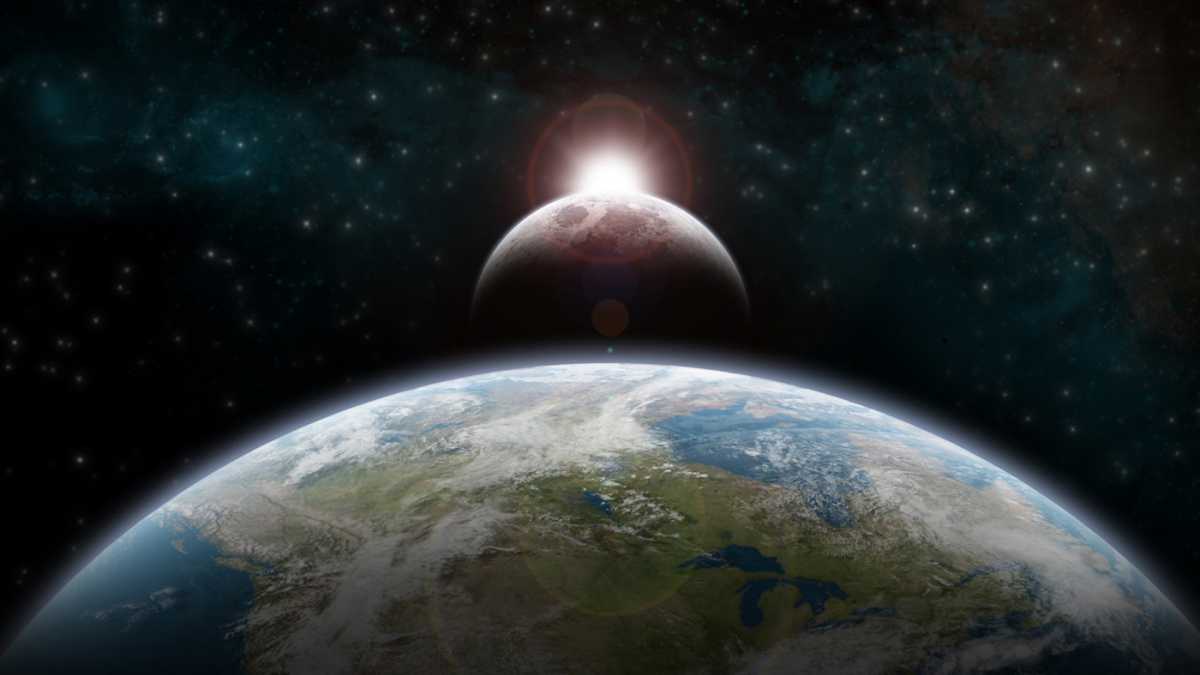
Muslims recognize that everything in the heavens and on earth is created and sustained by the Lord of the universe, Allah Almighty. Throughout the Quran, people are encouraged to observe and reflect on the beauties and wonders of the natural world - as signs of Allah's majesty.
"Allah is He, Who created the sun, the moon, and the stars -- (all) governed by laws under His commandment." (Surah al-A'raf, 54)
"It is He who created the night and the day and the sun and the moon. All (the celestial bodies) swim along, each in its orbit." (Surah al-Anbiya, 33)
"The sun and the moon follow courses exactly computed." (Surah ar-Rahman, 5)
Muslim Scholars on eclipses
Muslim scholars of the past have recorded in detail several eclipses of the Moon and the Sun, in different parts of the Muslim world. These observations are among the most accurate and reliable data from the pre-telescopic period.
Abu al-Rayhan al-Biruni (d. 1048), the famous scientist who excelled in mathematical and applied astronomy, made various observations of eclipses. In his book Kitab Tahdid nihayat al-amakin li-tashih masafat al-masakin (The Determination of the Coordinates of Positions for the Correction of Distances between Cities) he notes:
"The faculty of sight cannot resist it [the Sun's rays], which can inflict a painful injury. If one continues to look at it, one's sight becomes dazzled and dimmed, so it is preferable to look at its image in water and avoid a direct look at it, because the intensity of its rays is thereby reduced… Indeed such observations of solar eclipses in my youth have weakened my eyesight."
In Afghanistan, he observed and described the solar eclipse on April 8, 1019, and the lunar eclipse on September 17, 1019, in detail, and gave the exact latitudes of the stars during the lunar eclipse.
On the solar eclipse which he observed at Lamghan, a valley surrounded by mountains between the towns of Qandahar and Kabul, he wrote:
"At sunrise we saw that approximately one-third of the sun was eclipsed and that the eclipse was waning."
He observed the lunar eclipse at Ghazna and gave precise details of the exact altitude of various well-known stars at the moment of first contact.
Source: Islamicity






© islom.uz 2003-2026.
All rights reserved. When using the site materials reference is obligatory.
Email: admin@islom.uz
Telegram: @portalislomuzadmin_bot
Uzbekistan, Tashkent, 100185
Sogalli ota street, 5


